Our Beliefs
An overview of the five pillars of mystery presented on the current GTHBA website and their scriptural foundations.
The five pillars of mystery
GTHBA presents faith as foundational to Christian life and describes five mysteries that express the Ethiopian Orthodox Church’s confession of faith: the Trinity, Incarnation, Baptism, Holy Communion, and Resurrection of the Dead.
The Father, Son, and Holy Spirit are confessed as three in name and person while being one in divine essence, existence, and will. Each Person remains distinct without becoming the other, yet the Church confesses one God rather than three gods.
The present GTHBA text points to both Old and New Testament passages in discussing unity and Trinity, including Genesis 1:26, Isaiah 6:3, Matthew 3:16, Matthew 28:19, John 14:26, 1 Peter 1:2, and 1 John 5:7–8.
One God • Father • Son • Holy SpiritThe Incarnation is presented as God the Son taking true human flesh and a rational soul from the Holy Virgin Mary. The teaching emphasizes Christ as fully divine and fully human in one united Person, without confusion, change, separation, or division.
The current text connects the Incarnation with humanity’s fall, God’s promise of redemption, Christ’s birth, earthly ministry, death, resurrection, ascension, and future judgment. References include John 1:14, Isaiah 7:14, Galatians 4:4, Hebrews 2:14–16, and Acts 2:30.
The Word became fleshBaptism is described as a sacrament of faith, forgiveness, adoption, and entry into the life of God’s kingdom. The Church teaches baptism in the name of the Trinity and connects it with spiritual rebirth through water and the Spirit.
The current material cites John 3:5, Mark 16:16, Ezekiel 36:25, 1 Peter 3:19, 1 Corinthians 10:2, and Christ’s baptism in the Jordan. It also notes the traditional Ethiopian Orthodox practice of baptizing infant boys on the fortieth day and girls on the eightieth day.
Water • Spirit • New lifeHoly Communion is presented as intimate communion with God and participation in the true Body and Blood of Christ. GTHBA’s current text emphasizes that the Eucharist is not understood merely as a symbol or memorial.
The teaching is connected with John 6:53–57, Old Testament types such as the Passover lamb and Melchizedek’s bread and wine, and the institution of the Eucharist in Matthew 26, Mark 14, and Luke 22.
Bread • Wine • CommunionThe resurrection is the hope of life after death. The current teaching states that, at Christ’s return, the dead will rise and body and soul will be reunited for judgment. The righteous and unrighteous alike are raised, with final judgment according to God’s justice.
Scriptural references cited on the current site include Deuteronomy 32:39, Isaiah 26:19–20, Daniel 12:1–3, Job 19:25–27, John 5:28, 2 Corinthians 4:14, Matthew 25:31–32, and Revelation 20:12.
Resurrection • Judgment • Eternal life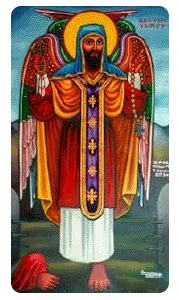
Saint Tekle Haymanot
Saint Tekle Haymanot (Takla Haymanot, “Plant of Faith”), c. 1215–1313, is remembered as an Ethiopian monk and founder of a major monastic community. He is venerated in the Ethiopian and Coptic Orthodox traditions.
His feast is observed on August 17, and the 24th day of each Ethiopian-calendar month is traditionally dedicated to his remembrance.